one sentence answer
There is no perfect tool in the world. The skill of top creators is to adapt to the "shortcomings" of the tool and package it into the most amazing "features".
From "technical flaws" to "artistic style"
In the AI short film "Zombie Scavenger" independently completed by Liu Ziyu (Mx-Shell), there is a detail that has amazed countless professional film and television people.
When the current AI video generation technology processes "human facial micro-expressions", it is easy to produce a sticky, distorted and stiff feeling, commonly known as the "uncanny valley effect". If you want to forcibly generate a realistic human face and express complex joys and sorrows, it often requires huge computing power for rendering or manual repair in the later stage.
Liu Ziyu's choice was very smart: **He directly gave up on generating a human protagonist. **
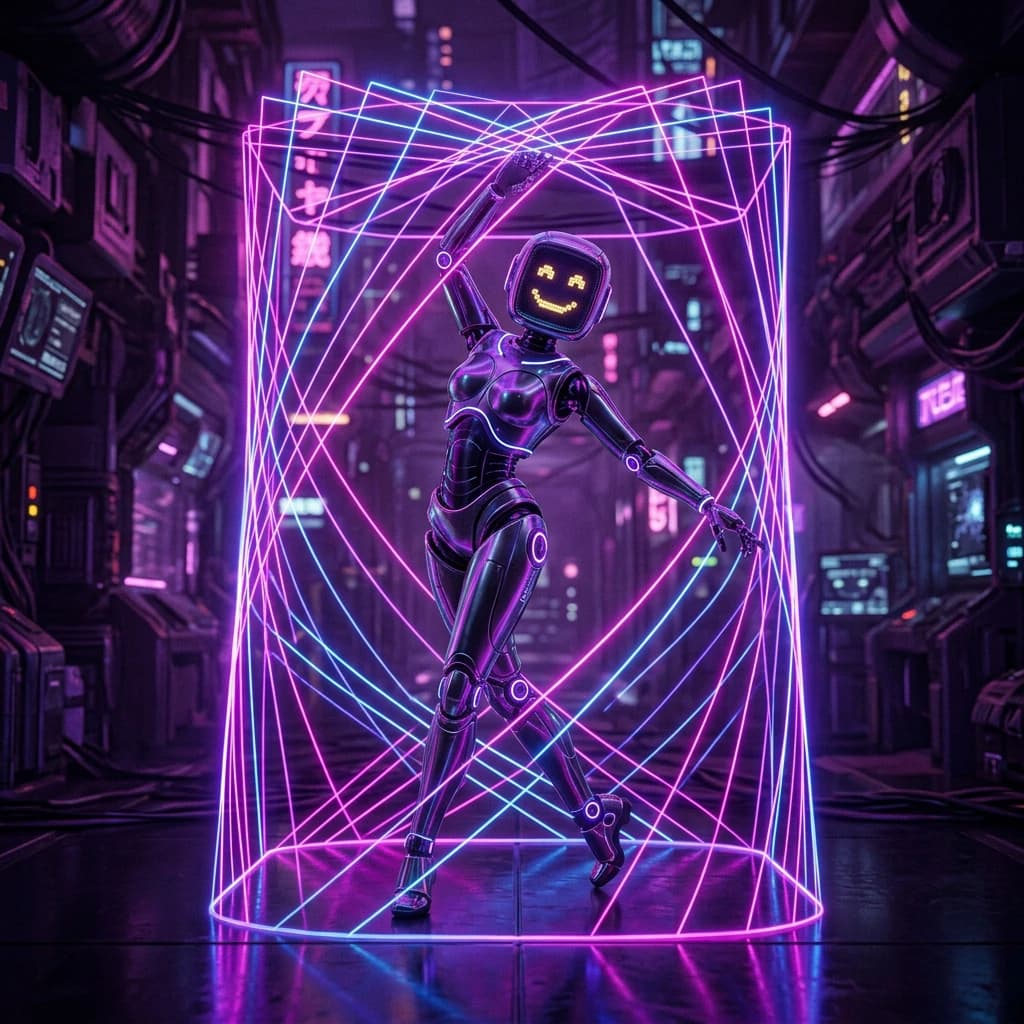
He designed the protagonists of the short film to be "mechanical zombies" and "dolls" with a cyberpunk feel. The robot’s face is a pixelated LED screen. When the protagonist wants to express shyness, anger, or sadness, pixelated emoticons flash across the screen.
This clever design:
- It completely avoids the shortcomings of AI-generated human expressions.
- Save dozens of hours of detailed rendering work.
- It gives the film a unique independent science fiction film quality (similar to the classic animation "Love to Death").
This is a classic example of using "technical limitations" to achieve a creative breakthrough.
Every technical limitation is a treasure map for creativity
When many business owners, marketing managers or designers use AI, they are often frustrated because “the pictures produced by AI are not realistic enough” or “the copywriting has an AI tone”, and they even conclude that AI is “not easy to use”.
In fact, smart creators are all following the trend of creativity:
1. Avoid the stiffness of real faces ➡️ Use surreal or cartoon style
If your brand copy or social media posters don’t require 100% real-life photos, you might as well try illustration style, clay style, 3D cartoon or glitch art. The AI handles these styles flawlessly without ever feeling "plasticky".
2. Avoid clichés that generate long sentences ➡️ Forcibly limit the word count and format of AI
Do you think the Xiaohongshu or Facebook promotion copy written by AI is too long and full of empty words? You can add strong restrictions to the prompt words:
- "Please use short sentences, no more than 15 words each."
- “Use local Malaysian Chinese colloquial words such as ‘boss’, ‘package’, ‘Jio’, etc. to get closer.”
- “Use emojis for layout separation to avoid long sentences.”
3. Avoid incoherent shots ➡️ Use fast-paced stream-of-consciousness editing
When making AI videos, it's currently difficult to make a shot last longer than 10 seconds without distortion. Since this is the case, then follow its rules: control the shot between 2-4 seconds, match it with dynamic background music, and adopt a montage, collage or stream-of-consciousness editing style. This not only maintains high image quality, but also makes the entire short film appear rhythmic.
Summary: It’s not that the tools are not good enough, it’s that the gameplay needs to be flexible.
In the AI era, one of the most needed abilities for individual creators is the design thinking of "dancing in shackles".
Don’t struggle with the shortcomings of the tool. Find out what the current AI tools can and cannot do, and then hide its shortcomings from the starting point of creativity, or even turn them into a signature feature of your work.
After all, limitations are often the best catalysts for inspiration.
FAQ
Can today’s AI tools really completely replace professional editors and designers?
cannot. AI can provide 60 to 80 points of visual materials and copywriting framework at an extremely fast speed, but the remaining 20 points (such as picture rhythm adjustment, brand tonality control, and fine-tuning of details) still rely heavily on the judgment and experience of human professionals.
If I write with AI, how can I avoid being deemed “AI-generated spam” by Google?
Google values content’s “uniqueness and practical value” (EEAT Framework). Avoid completely copying AI output, and be sure to inject your personal real-life experience, localized business cases, or your unique counter-intuitive views into the content.