One-Sentence Answer
NVIDIA's Nemotron isn't trying to replace ChatGPT or Claude — it's solving a different problem: making multi-agent AI systems efficient, scalable, and cost-effective with hybrid architecture and 1M token context windows.
The Question: Why Does NVIDIA Have Its Own LLM?
When you think of NVIDIA, you think of GPUs — the hardware that powers ChatGPT, Claude, and every other major AI model. So why is NVIDIA building its own language models?
The answer reveals a fundamental split in the AI landscape: frontier models (ChatGPT, Claude, Gemini) optimize for general intelligence and reasoning, while infrastructure models (Nemotron) optimize for efficiency, scale, and specialized workloads like multi-agent systems.
Understanding this distinction — and when to use each — is critical for developers building AI products in 2026.
What Is Nemotron?
Nemotron is NVIDIA's family of open-source large language models, designed specifically for agentic AI — systems where multiple AI agents collaborate to complete complex tasks.
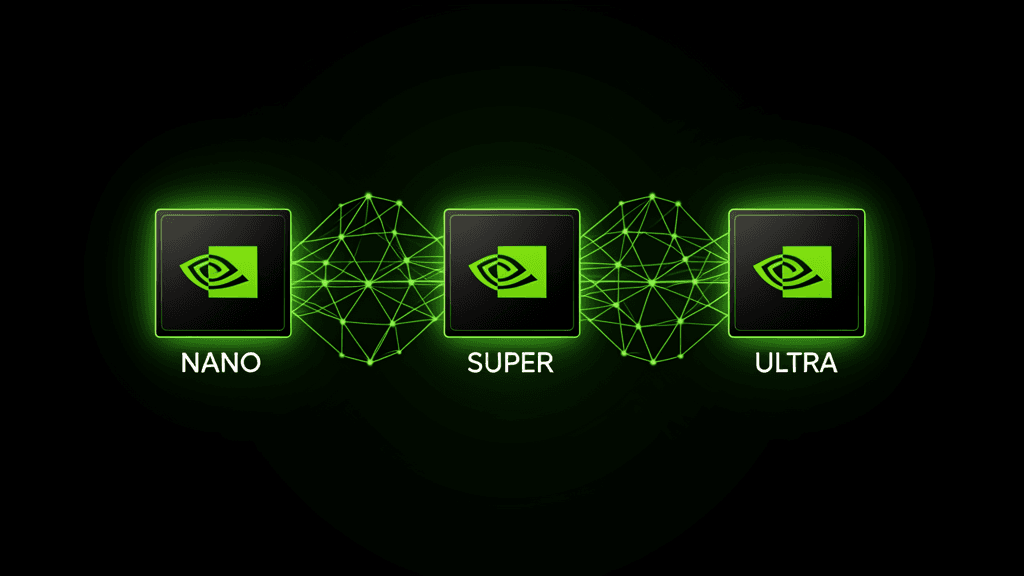
Released in December 2025 and expanded through 2026, the Nemotron 3 family includes three models:
| Model | Total Parameters | Active Parameters | Context Window | Best For | |-------|------------------|-------------------|----------------|----------| | Nemotron 3 Nano | 30B | 3B | 1M tokens | High-volume, cost-sensitive tasks | | Nemotron 3 Super | 120B | 12B | 256K tokens | Multi-agent coordination | | Nemotron 3 Ultra | 500B | 50B | 256K tokens | Complex reasoning engines |
The key innovation: hybrid latent Mixture-of-Experts (MoE) architecture. Instead of activating all parameters for every token, Nemotron routes each token through a small subset of specialized expert networks. This dramatically reduces inference costs while preserving the capacity of a much larger model.
For example, Nemotron 3 Super has 120B total parameters but only activates 12B per token. This makes it behave like a 120B model in capability while running like a 12B model in speed and cost.
The Architecture: Mamba + Transformer + MoE
What makes Nemotron genuinely different from ChatGPT or Claude is its hybrid Mamba-Transformer MoE architecture.
Why Not Just Use Transformers?
ChatGPT, Claude, and most frontier models use pure Transformer architecture. Transformers are excellent at reasoning but have a critical limitation: quadratic memory scaling. Processing 1M tokens with a Transformer requires memory proportional to 1M², making long contexts prohibitively expensive.
Enter Mamba
Mamba is a state-space model — a different approach to sequence processing that scales linearly with context length. It's much more memory-efficient than Transformers for long sequences, but historically less accurate for precise reasoning tasks.
The Hybrid Solution
Nemotron combines both:
- Mamba layers handle long-range dependencies efficiently (low memory, fast processing)
- Transformer layers handle precise reasoning (high accuracy, complex logic)
- MoE layers route tokens to specialized experts (efficient parameter usage)
The result: Nemotron can process up to 1 million tokens in a single context window (Nano) or 256K tokens (Super/Ultra) without the memory explosion that pure Transformers would require.
This architectural choice isn't just technical — it's strategic. For multi-agent systems where agents need to maintain context over long conversations, process large documents, or coordinate across multiple steps, Nemotron's efficiency enables use cases that would be economically unfeasible with pure Transformers.
Benchmarks: Where Nemotron Wins (and Where It Doesn't)
Where Nemotron Excels: Agent Workloads
NVIDIA created PinchBench, a benchmark specifically for agent-based tasks (tool calling, multi-step reasoning, coordination). Here's how Nemotron 3 Super compares:
| Model | PinchBench Score | |-------|------------------| | Nemotron 3 Super | 85.6% | | Claude Opus 4.6 | 80.8% | | GPT-5.4 | 80.5% | | Qwen3.5 | 78.2% |
Nemotron leads by 4.8 percentage points on agent-specific tasks. This isn't about general intelligence — it's about the specific skills needed for autonomous AI systems: parsing tool outputs, maintaining state across multiple steps, generating valid function calls.
Efficiency Benchmarks
Nemotron 3 Nano (30B total, 3B active) delivers remarkable throughput:
| Metric | Nemotron 3 Nano | Qwen3-30B-A3B | GPT-OSS-20B | |--------|-----------------|---------------|-------------| | Inference throughput | 3.3x faster | Baseline | 2.2x slower | | AIME25 (with tools) | 99.2% | N/A | 98.7% | | SWE-Bench (OpenHands) | 38.8% | 22.0% | 34.0% | | LiveCodeBench v6 | 68.3% | 66.0% | 61.0% |
On a single H200 GPU, Nemotron 3 Nano processes tokens 3.3x faster than Qwen3-30B-A3B at the same parameter count. For production deployments, this translates directly to lower per-token costs.
Where Nemotron Falls Short: General Intelligence
On benchmarks measuring general reasoning, creative writing, or complex problem-solving, Nemotron doesn't lead:
- MMLU (general knowledge): GPT-4o and Claude score higher
- HumanEval (creative coding): Claude excels
- Complex reasoning (GPQA, MATH): Frontier models are stronger
This isn't a weakness — it's a design choice. Nemotron optimizes for system-level efficiency (throughput, coordination, long contexts) rather than single-model intelligence (peak reasoning capability).
Nemotron vs ChatGPT: Different Design Philosophies
ChatGPT (OpenAI)
Architecture: Dense Transformer (GPT-4, GPT-5)
Strengths:
- General-purpose intelligence and reasoning
- Creative writing and conversation
- Broad knowledge across domains
- Strong instruction following
Limitations:
- Closed-source (API only, no self-hosting)
- Context window: 128K tokens (GPT-4), 200K (GPT-5)
- Higher inference costs for long contexts
- Not optimized for multi-agent coordination
Best for: General assistants, content creation, complex reasoning tasks, single-model workflows
Nemotron (NVIDIA)
Architecture: Hybrid Mamba-Transformer MoE
Strengths:
- Agent workloads and tool calling (PinchBench leader)
- Long context windows (up to 1M tokens)
- High throughput and low inference costs
- Open-source (self-hostable, full control)
- Optimized for NVIDIA hardware
Limitations:
- Lower general intelligence scores
- Less creative writing capability
- Requires NVIDIA infrastructure for optimal performance
Best for: Multi-agent systems, autonomous workflows, long-document processing, cost-sensitive high-volume applications
Nemotron vs Claude: Different Optimization Targets
Claude (Anthropic)
Architecture: Dense Transformer with Constitutional AI
Strengths:
- Exceptional reasoning and analysis
- Strong coding capabilities (SWE-Bench leader)
- Excellent at nuanced, careful responses
- Good at following complex instructions
Limitations:
- Closed-source (API only)
- Context window: 200K tokens
- Higher costs for large-scale deployments
- Not specifically optimized for agent coordination
Best for: Complex analysis, careful reasoning, coding assistance, tasks requiring nuance and judgment
Nemotron (NVIDIA)
Architecture: Hybrid Mamba-Transformer MoE
Strengths:
- Multi-agent coordination (designed for agent swarms)
- Tool calling and function generation
- Efficiency at scale (MoE reduces active parameters)
- Open-source with full transparency
Limitations:
- Less nuanced than Claude for careful reasoning
- Weaker on pure coding benchmarks (SWE-Bench)
- Requires understanding of Mamba/Transformer trade-offs
Best for: Agent orchestration, high-throughput workflows, self-hosted deployments, cost-optimized production systems
Real-World Use Cases: When to Choose Each
Choose ChatGPT When:
- Building a general-purpose chatbot for customer service or internal tools
- Content creation — articles, marketing copy, creative writing
- Complex reasoning — legal analysis, strategic planning, research synthesis
- Rapid prototyping — quick iteration without infrastructure concerns
Example: A law firm building an AI assistant to analyze contracts and provide legal guidance would benefit from ChatGPT's strong reasoning and broad knowledge.
Choose Claude When:
- Careful, nuanced tasks — medical analysis, ethical reasoning, sensitive content
- Coding assistance — Claude leads on SWE-Bench and excels at code review
- Complex instruction following — tasks requiring precise adherence to guidelines
- Research and analysis — deep dives requiring careful reasoning
Example: A software team using AI for code review and debugging would benefit from Claude's exceptional coding capabilities and careful analysis.
Choose Nemotron When:
- Building multi-agent systems — dozens or hundreds of AI agents coordinating
- Long-context workflows — processing entire codebases, long documents, extended conversations
- Cost-sensitive production — high-volume applications where inference costs matter
- Self-hosted deployments — data privacy requirements, on-premises infrastructure
- Agent-specific tasks — tool calling, function generation, state management
Example: A company building an autonomous customer service system with multiple specialized agents (billing, technical support, sales) would benefit from Nemotron's agent optimization and efficiency.
The ILMU Console Case Study
ILMU Console (Malaysia's sovereign AI platform) chose Nemotron-3-Super for its Claw plans. Why?
-
Agent workloads: ILMU powers autonomous AI assistants that need reliable tool calling and multi-step reasoning. Nemotron leads PinchBench at 85.6%.
-
Efficiency: ILMU serves thousands of Malaysian developers. Nemotron's MoE architecture (120B total, 12B active) keeps inference costs manageable at scale.
-
Open-source control: ILMU fine-tuned Nemotron for Malaysian context (Manglish, Bahasa Malaysia, local business terminology). Open weights made this possible.
-
Data sovereignty: Self-hosting on YTL AI Cloud ensures 100% Malaysian data residency. ChatGPT and Claude can't offer this.
For ILMU's use case — agent-based AI with local context and data sovereignty — Nemotron is the right choice. For a Malaysian law firm needing general legal analysis, ChatGPT or Claude might be better.
Technical Deep Dive: Why Mamba Matters
To understand why Nemotron's architecture is significant, let's compare memory requirements for processing 1M tokens:
| Architecture | Memory Scaling | 1M Token Memory Cost | |--------------|----------------|----------------------| | Pure Transformer | O(n²) | ~1TB (prohibitive) | | Pure Mamba | O(n) | ~10GB (feasible) | | Hybrid Mamba-Transformer | O(n) with Transformer bursts | ~50GB (practical) |
Pure Transformers can't economically process 1M tokens — the quadratic memory scaling makes it prohibitively expensive. Pure Mamba can, but loses some reasoning accuracy. The hybrid approach gets the best of both worlds.
This enables use cases that were previously impossible:
- Full codebase analysis — process an entire repository in one context
- Long-document RAG — retrieve and reason over hundreds of pages
- Multi-hour conversations — maintain context across extended interactions
- Multi-agent coordination — dozens of agents sharing a large context window
The Open-Source Advantage
Unlike ChatGPT and Claude, all Nemotron models are fully open-source:
- Open weights (download and self-host)
- Open training data (inspect what the model learned)
- Open recipes (reproduce training, fine-tune for your domain)
This transparency enables:
- Data privacy — self-host on your infrastructure, data never leaves
- Custom fine-tuning — adapt models to your specific domain
- Cost control — no per-token API fees, predictable infrastructure costs
- Regulatory compliance — meet data residency requirements (like Malaysia's PDPA)
For enterprises in regulated industries (healthcare, finance, government), this openness is often the deciding factor.
The Ecosystem: Beyond Just Models
NVIDIA's strategy extends beyond Nemotron models:
- NVIDIA NIM — deployment framework for secure, scalable inference
- NeMo Gym — reinforcement learning environments for agent training
- NeMo Framework — end-to-end platform for training and deploying AI
- Blackwell architecture — next-gen GPUs optimized for Nemotron's 4-bit precision
This full-stack approach means Nemotron isn't just a model — it's part of an integrated platform for building production AI systems.
Performance on NVIDIA Hardware
Nemotron is specifically optimized for NVIDIA GPUs:
| Hardware | Nemotron 3 Nano Throughput | Cost per 1M Tokens | |----------|----------------------------|---------------------| | H100 | 850 tokens/sec | ~$0.08 | | H200 | 1,200 tokens/sec | ~$0.06 | | Blackwell (B200) | 2,500 tokens/sec | ~$0.03 |
On Blackwell architecture (NVIDIA's latest), Nemotron uses 4-bit NVFP4 precision, cutting memory requirements by 75% while maintaining accuracy. This makes large-scale deployments economically feasible.
For comparison, running equivalent workloads on ChatGPT API at $15/1M tokens (GPT-4o) would cost 250x more than self-hosting Nemotron on Blackwell hardware.
The Trade-Offs: What You Give Up
Choosing Nemotron over ChatGPT or Claude means accepting trade-offs:
What You Gain:
- ✅ Lower inference costs (especially at scale)
- ✅ Longer context windows (1M vs 128K-200K)
- ✅ Better agent coordination (PinchBench leader)
- ✅ Full control and customization (open-source)
- ✅ Data privacy (self-hosting)
What You Give Up:
- ❌ Lower general intelligence (MMLU, GPQA scores)
- ❌ Less creative writing capability
- ❌ Requires NVIDIA infrastructure for optimal performance
- ❌ More complex deployment (self-hosting vs API)
- ❌ Smaller ecosystem (fewer third-party integrations)
Conclusion: Different Tools for Different Jobs
The AI landscape in 2026 isn't about finding the "best" model — it's about matching the right model to your specific workload:
- ChatGPT for general-purpose intelligence and creative tasks
- Claude for careful reasoning, coding, and nuanced analysis
- Nemotron for multi-agent systems, long contexts, and cost-efficient scale
NVIDIA's bet with Nemotron isn't that it will replace ChatGPT or Claude. It's that as AI systems evolve from single-model assistants to multi-agent workflows, the infrastructure layer will become critical — and NVIDIA will own that layer.
For developers building AI products in 2026, the question isn't "which model is best?" It's "which model is right for my use case?" Understanding the architectural and philosophical differences between Nemotron, ChatGPT, and Claude is the first step to making that decision.
Extended Reading
- NVIDIA Nemotron official page
- Nemotron 3 technical blog
- ILMU Console platform guide — how Malaysia uses Nemotron for sovereign AI
- What LLM powers ILMU? — deep dive into ILMU's dual-track model strategy