TL;DR
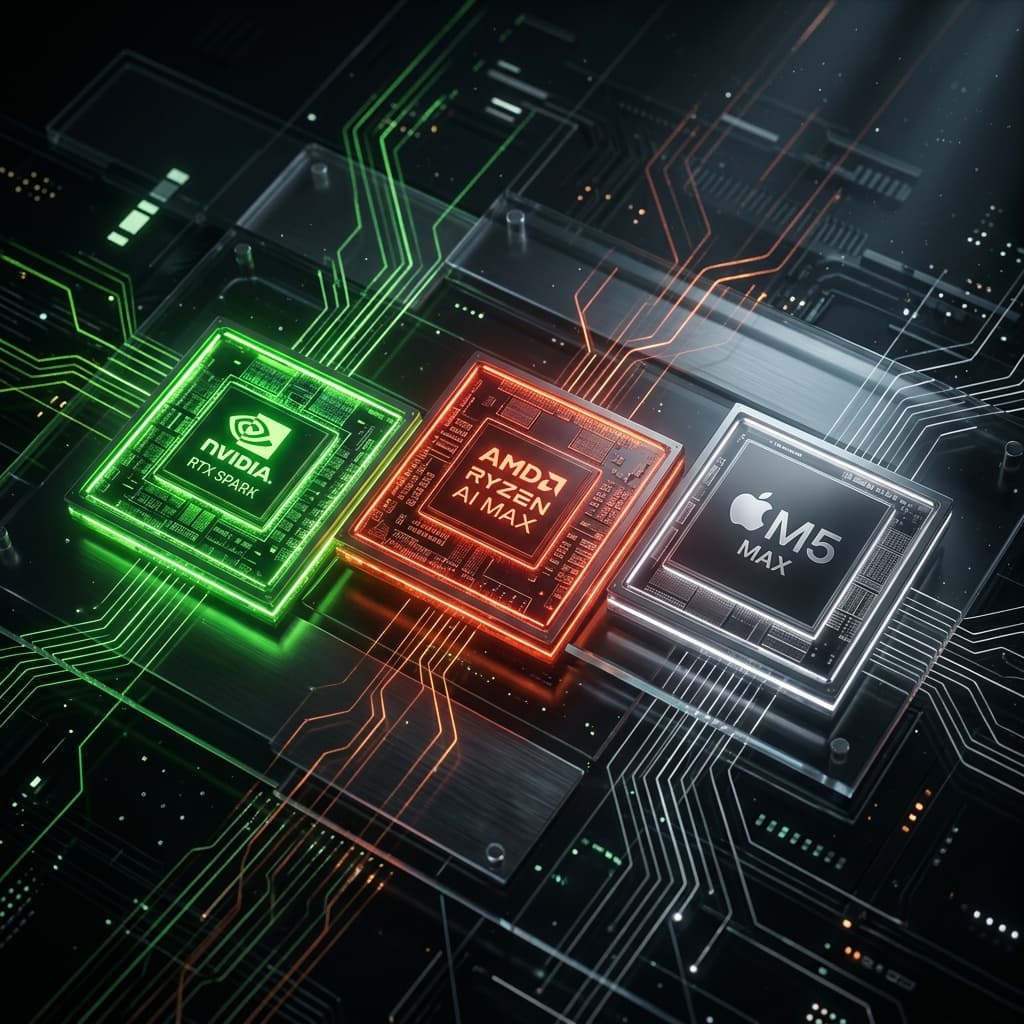
The late 2026 local AI hardware landscape is a three-way battle: Nvidia RTX Spark leverage the Blackwell GPU and CUDA ecosystem to be the absolute choice for personal AI agents; AMD Ryzen AI Max dominates heavy local LLM inference and workstations with its monstrous 192GB unified memory; and Apple M5 Max stands undefeated in single-core performance, thermal management, and power efficiency via its 3nm Fusion SoC.
The Shift to Unified Architectures in 2026
In the past, running Large Language Models (LLMs) locally meant relying on power-hungry discrete desktop GPUs or paying for high-latency cloud APIs. However, with the rise of Agentic AI—autonomous agents executing tasks locally in the background—developers and power users now demand near-zero latency, data privacy, and massive memory bandwidth.
This has forced Nvidia, AMD, and Apple to adopt a similar architectural philosophy: ultra-fast unified memory architectures and deeply integrated heterogeneous system-on-chips (SoCs).
Specifications & Core Tech Metrics Comparison
Before diving deeper, let's examine the raw hardware specifications of the three contenders:
| Spec / Parameter | Nvidia RTX Spark | AMD Ryzen AI Max (PRO 495) | Apple M5 Max | | :--------------------------- | :--------------------------------- | :-------------------------------------- | :--------------------------------------- | | Processor Architecture | Arm (Grace CPU + Blackwell GPU) | x86 (Zen 5 CPU + RDNA 3.5 GPU) | Apple Silicon (3nm Fusion SoC) | | CPU Cores | 20-Core Nvidia Grace (Arm) | 16-Core Zen 5 | 18-Core (6 Super Cores + 12 Perf Cores) | | GPU Architecture / Cores | Blackwell (6,144 CUDA Cores) | RDNA 3.5 (Up to 40 Compute Units) | Apple GPU (Up to 40 Cores) | | Max Unified Memory | 128GB LPDDR6 | 192GB LPDDR5X-8533 | 128GB LPDDR6 | | Memory Bandwidth | ~512 GB/s | ~546 GB/s | ~600 GB/s | | Local AI Performance | 1 Petaflop (FP4 Tensor) | 80+ NPU TOPS (XDNA 2) | 16-Core Enhanced Neural Engine + GPU | | Primary Target | Local Multi-Agent, Windows Arm Dev | Large LLM Workstations, Heavy Inference | Pro Creative Workflows, macOS Developers | | Availability | Fall 2026 (OEM Laptops/Minis) | Q3 2026 (Workstations/Laptops) | Available Now (MacBook Pro 14/16) |
Front 1: Nvidia RTX Spark — The Arm Powerhouse Built for Local Agents
Unveiled at Computex 2026, the Nvidia RTX Spark represents Nvidia's first dedicated unified superchip designed for the premium client PC segment.
1. Grace-Blackwell Fusion
The RTX Spark fuses a 20-core Grace CPU with a Blackwell-based GPU on a single package. Delivering up to 1 Petaflop of FP4 AI compute, it is optimized to run highly quantized open-source models locally at lightning speeds.
2. A Sandbox for Agentic Workflows
The true appeal of RTX Spark lies in its hardware-accelerated sandboxing. For developers running multi-agent networks (e.g., AutoGen or CrewAI) locally, the unified architecture eliminates PCIe latency entirely. Furthermore, having native CUDA support on a high-bandwidth laptop means zero translation layers for AI development tools.
Front 2: AMD Ryzen AI Max — The 192GB Workstation Beast
AMD's platform, codenamed "Gorgon Halo", is a direct assault on Apple's unified memory dominance in the professional workstation market.
1. 192GB Unified Memory Supremacy
For researchers looking to load large models like Llama 3 70B or massive MoEs (Mixture of Experts) locally, VRAM is the ultimate bottleneck. AMD answers this by offering up to 192GB of LPDDR5X-8533 unified memory. It allows AI practitioners to load and fine-tune models containing over 100 billion parameters on a single compact APU workstation, bypassing the need for multi-GPU desktop towers.
2. Zen 5 + XDNA 2 Synergy
Beyond raw graphics and memory, the Ryzen AI Max features AMD's XDNA 2 NPU, pushing over 80 TOPS of dedicated NPU throughput. This handles low-power tasks like Windows Copilot+ natively while leaving the RDNA 3.5 compute units free for heavy math.
Front 3: Apple M5 Max — The 3nm Efficiency King
Released in early 2026, the Apple M5 Max shows the refinement of Apple's packaging technology and silicon architecture.
1. 3nm Fusion and "Super Cores"
Using a 3nm Fusion interconnect, the M5 Max bridges dual dies seamlessly. Its CPU debuts 6 new "Super Cores" that lead the industry in single-threaded compilation speed and code translation efficiency.
2. Ecosystem Integration
The M5 Max implements dedicated neural accelerators within each GPU cluster, complementing a 16-core Neural Engine. While its max memory capacity is capped at 128GB, its memory bandwidth of 600 GB/s makes token generation speeds for models like Mistral and Llama incredibly fast, all while maintaining silent fan profiles and long battery life.
Which Chip Should You Choose?
1. The Local AI & Multi-Agent Developer
- Recommended: Nvidia RTX Spark
- Why: The AI software landscape is fundamentally built on CUDA. RTX Spark gives developers a low-power, unified platform to write, debug, and execute complex agentic scripts natively in PyTorch and TensorRT without compatibility issues.
2. The Heavy LLM Researcher & Data Scientist
- Recommended: AMD Ryzen AI Max
- Why: The 192GB unified memory capacity is unmatched in this form factor. If your goal is to load giant 70B+ models locally or run local vector databases on complex data subsets, AMD's memory size makes it the most cost-efficient choice on the market.
3. The Full-Stack Dev, Pro Creator, and Digital Nomad
- Recommended: Apple M5 Max
- Why: MacBook Pro's integration of M5 Max offers the finest blend of performance, heat management, and screen/audio hardware. For developers who code on the go and require stable local AI assistants, the M5 Max is still the premier portable machine.
Summary
The chip war of 2026 proves that raw flops are no longer the only metric that matters. Unified memory bandwidth, local agent sandboxing, and NPU integration are defining the next era of personal computing. Whichever path you choose, you are looking at desktop-grade AI capabilities sitting quietly on your lap.