
Introduction
Today (July 11, 2026), OpenAI officially pushed the long-rumored GPT-5.6 into the spotlight, led by a flagship model called Sol. Unlike the previous round — limited to a handful of private-preview partners — this launch arrives with a complete pricing structure and a clear positioning.
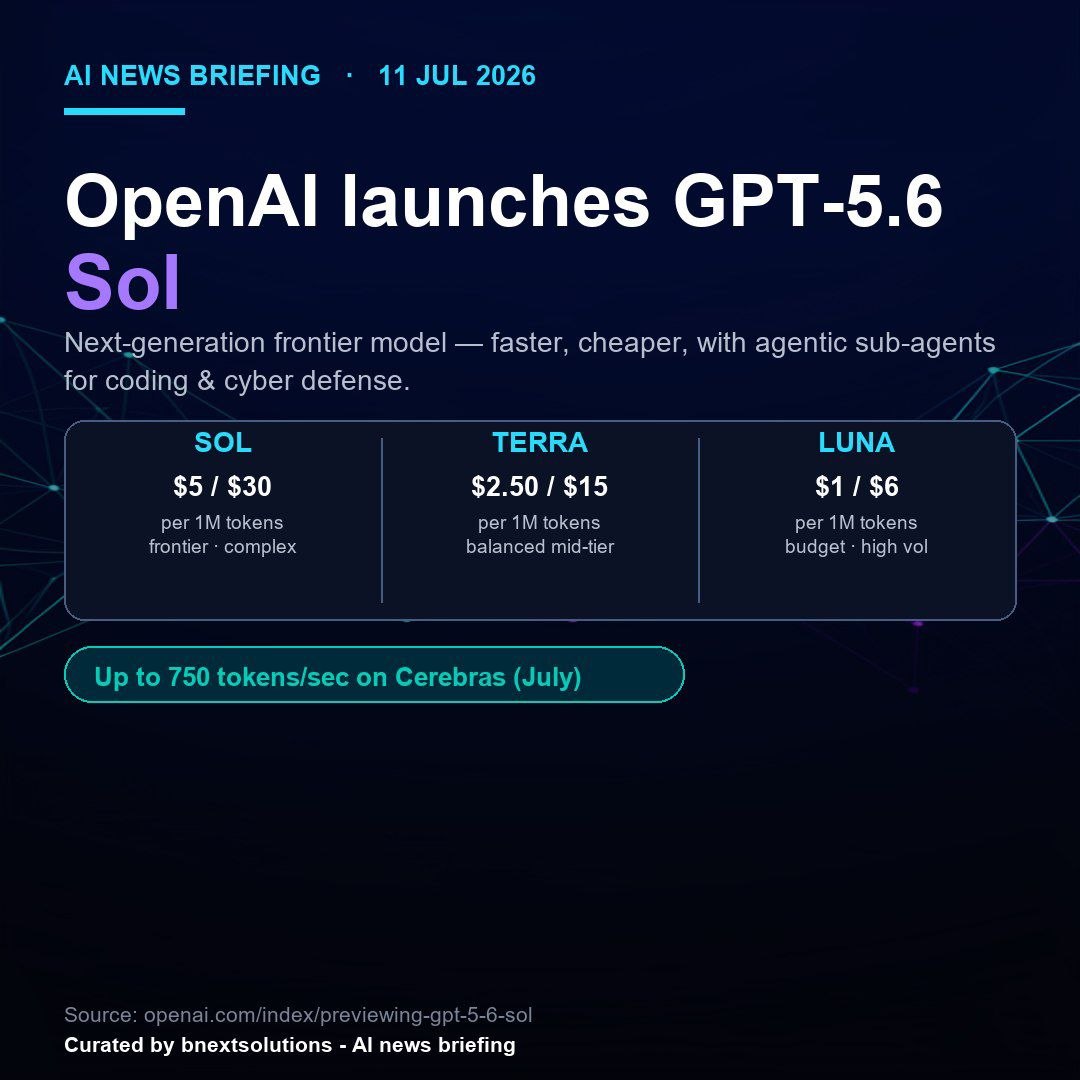
The part everyday people should care about is not "it got a bit bigger." It is two things: prices dropped meaningfully, and the model itself can now dispatch sub-agents to write code and run cyber defense. In other words, it does not just answer in the chat box — it can roll up its sleeves and get work done.
Below, a clear breakdown of the pricing, the performance, and what it actually means for you — a creator, a small-business owner, or someone just getting started with AI.
What GPT-5.6 Is: A Three-Tier Lineup
GPT-5.6 is no longer a one-size-fits-all model. It splits into three tiers, ordered from most capable to most affordable:
- Sol: The flagship frontier model for complex reasoning, deep code refactoring, and high-stakes cyber-defense work. OpenAI emphasizes its built-in agentic sub-agents that can autonomously break down problems, write code, and run security analysis.
- Terra: The balanced mid-tier — a cost/performance compromise for most business automation.
- Luna: The high-volume tier, tuned for concurrency and rock-bottom cost, aimed at budget-sensitive, high-traffic daily tasks.
A quick memory hook: Sol is strongest, Terra is most balanced, Luna is most affordable.
Pricing: This Time It Is Genuinely Cheap
Official per-million-token pricing (input / output):
- SOL:
$5 / $30per million tokens — frontier model, complex work - TERRA:
$2.50 / $15per million tokens — balanced mid-tier - LUNA:
$1 / $6per million tokens — budget tier, high volume
Compared with previous-generation frontier models that ran $10–$50, Sol's $5 / $30 pulls "flagship capability" down to what used to be mid-tier pricing. For ordinary creators, that means you can finally afford top-tier logic and coding power without settling for a cheaper compromise.
Speed: Up to 750 Tokens/sec on Cerebras
Beyond the price cut, OpenAI dropped a hard performance number: on Cerebras dedicated hardware, GPT-5.6 hits up to 750 tokens/sec (July 2026 benchmark).
What does that mean? Early models spit out a few dozen tokens per second and made long text or code wait forever. At 750 tokens/sec, a few-hundred-word reply fills the screen almost instantly, and real-time chat plus streaming code completion feel far smoother. For anyone producing AI video scripts, batch-generating copy, or using it as a coding partner, that speed-up is real productivity.
What It Means for Everyday Creators & Small Business
Stripping away the specs, this launch sends three direct signals:
- Flagship capability is being democratized. Sol's pricing puts reasoning and coding power that only big companies could afford into the budget of individuals and small teams.
- "An AI that does the work" becomes the default shape. Sub-agents mark the shift from "answers questions" to "executes tasks" — you give the goal, it plans the steps, writes the code, and checks its own work.
- Cost stays controllable. Three tiers let you match the model to the task: the brain-burners go to Sol, the routine stuff goes to Luna, and the bill stays sane.
If you run content, e-commerce, or a local service in Malaysia, you could stand up a "24/7 business assistant" on Sol: write copy, revise landing pages, troubleshoot your site — then route the high-frequency repeats to Luna to keep costs down.
Conclusion
The headline of GPT-5.6 "Sol" is not "it got a bit bigger" — it is cheaper + it works on its own + it is faster. The three-tier pricing ($5/$30, $2.50/$15, $1/$6) fits flagship power into an ordinary person's budget, and 750 tokens/sec makes real-time collaboration actually usable. For creators and small businesses, this is the moment AI goes from "toy" to "employee."
Note: Pricing and performance figures above come from OpenAI's official launch graphic (openai.com/index/previewing-gpt-5-6-sol). Actual prices and regional availability are subject to the official announcement.