One-Sentence Answer
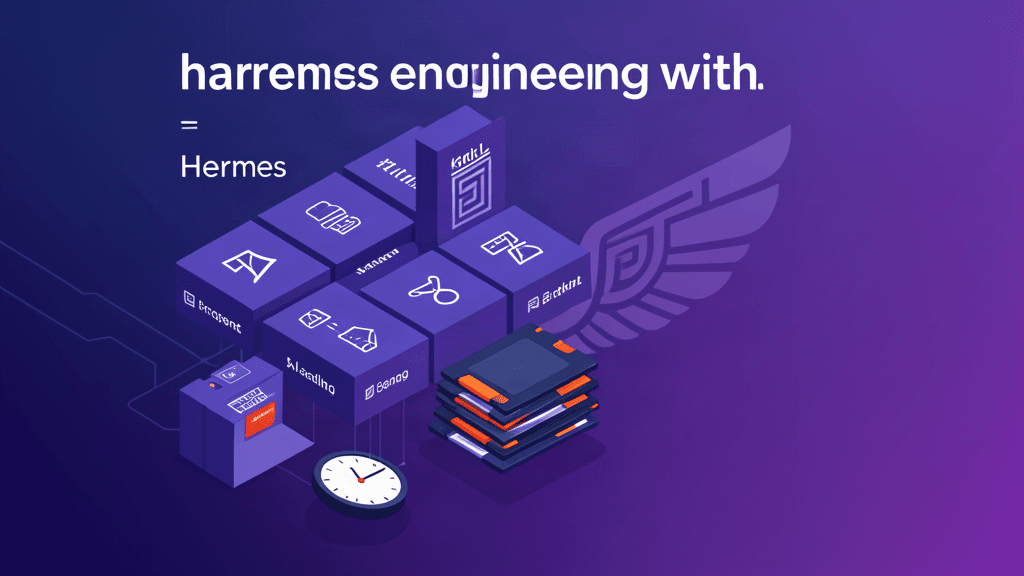
Hermes Agent by Nous Research is harness engineering delivered as a running system: instead of you hand-building memory, skills, tool execution, and scheduling, Hermes ships those layers so an open-source AI agent can do reliable, multi-step work from your terminal or phone.
In the overview we defined a harness as everything around the model: tools, memory, state, feedback, and guardrails. ChatGPT leaves most of that to you. Hermes starts much closer to a complete harness — which is why it is a clean way to see the discipline in practice.
The Problem Hermes Solves by Design
Most AI interfaces share three weaknesses: they forget you between sessions, they lock you to one provider, and they live in one place (a browser tab or a terminal). Hermes was built to remove all three at once.
As covered in the site's Hermes explainer, Hermes is an open-source agent that runs on your own machine — Windows, macOS, or Linux — and makes itself available wherever you are: terminal, desktop app, or Telegram, Discord, Slack, WhatsApp, Signal, Teams and 15+ other platforms.
That alone is a harness-shaped architecture, not a chat window.
Hermes as a Harness: The Layers It Ships
Map Hermes's features onto the harness layers from the overview article.
1. Memory and state (persistent)
Hermes remembers your preferences, project details, environment setup, and past decisions permanently. Where a raw model is stateless, Hermes carries state across sessions — the foundational harness layer.
2. Feed-forward guidance: skills
Hermes gets smarter by saving skills — reusable procedure documents it loads when relevant. A skill is exactly the "inferential guidance" a good harness needs: written rules, references, and how-tos that make the right path the easy path.
3. Tool execution
Hermes can run commands on your system: git, file management, API calls, web browsing, image generation. It is not describing actions; it executes them and feeds results back into the loop.
4. Scheduling (the feedback clock)
Hermes supports cron-style scheduled tasks that run without you present and deliver results to your phone. That is a standing feedback and execution loop — the kind of long-running behavior a thin harness cannot provide.
5. Cross-surface reach
The same tools work from terminal, desktop, or messaging apps. The harness is not trapped in one interface, so you can steer it from wherever you are.
6. Model choice
Hermes works with any LLM provider — OpenAI, Anthropic, Google, Nous Portal, DeepSeek, xAI, local models, and 20+ more. The model is a pluggable component, which is the whole point of separating model from harness.
A Harness Loop You Get for Free
With Hermes, the act-sense-correct-approve loop from the ChatGPT article is mostly built in:
| Step | Hermes behavior | | --- | --- | | Specify | Message from terminal or phone; skills load relevant procedure automatically | | Act | Executes commands, runs scripts, calls tools, manages git | | Sense | Reads test output, logs, and files; skills encode checks to run | | Correct | Feeds results back, iterates until the task passes its own checks | | Approve | You confirm before production writes or external sends |
You still own the approval boundary — but the sensing and correction happen inside the system, not in your head.
Guardrails You Still Set
Hermes gives you the harness; you set the policies. Keep these habits:
- Least privilege. Scope what the agent can touch; start read-only on anything real.
- Human checkpoint for ships. Production writes, deploys, emails, and payments wait for your confirmation.
- Review before publish. Anything external — a post, a client message, a commit to main — gets a human look first.
- Secrets stay out of chat. Keys live in environment config, never in prompts or files you paste around.
These are the approval and guardrail layers no harness can decide for you.
Hermes vs a Coding Agent
Hermes overlaps with Claude Code and OpenAI Codex: it edits code, runs tests, and manages git. The difference is breadth. A coding agent is optimized for focused coding sessions; Hermes is built as a persistent operator that also reaches your messaging apps, runs on a schedule, remembers across projects, and switches models. For deep coding sprints, Claude Code or Codex remain excellent. For a standing AI team member that lives in your daily workflow, Hermes is the more harness-complete default.
Key Takeaways
- Hermes ships the harness layers most setups make you build: memory, skills, execution, scheduling, and cross-platform reach.
- The model is pluggable — you can swap providers without rebuilding the harness.
- You still own guardrails: least privilege, human approval for anything that ships, secrets out of chat.
- If you want to understand the discipline first, start with what harness engineering is and how to apply it with ChatGPT.
Harness engineering is the skill of 2026. Hermes is one of the cleanest ways to run it.